What is the 4-Point Door Check?
The 4-Point Door Check is what we run through before a smart lock goes on any door. We made the name up, but the checks are real.
| Point | Question | What you're looking for |
|---|---|---|
| 1. Fit | Is the door drilled for this lock? | Bore size, backset, door thickness |
| 2. Alignment | Does the bolt slide freely? | A door that closes without lifting or pushing |
| 3. Connection | Can the lock reach your network? | Wi-Fi or hub range at the door |
| 4. Backup | What opens it when the power is gone? | A real key, a code, or a power-up option |
Point 1: Does the door fit the lock?
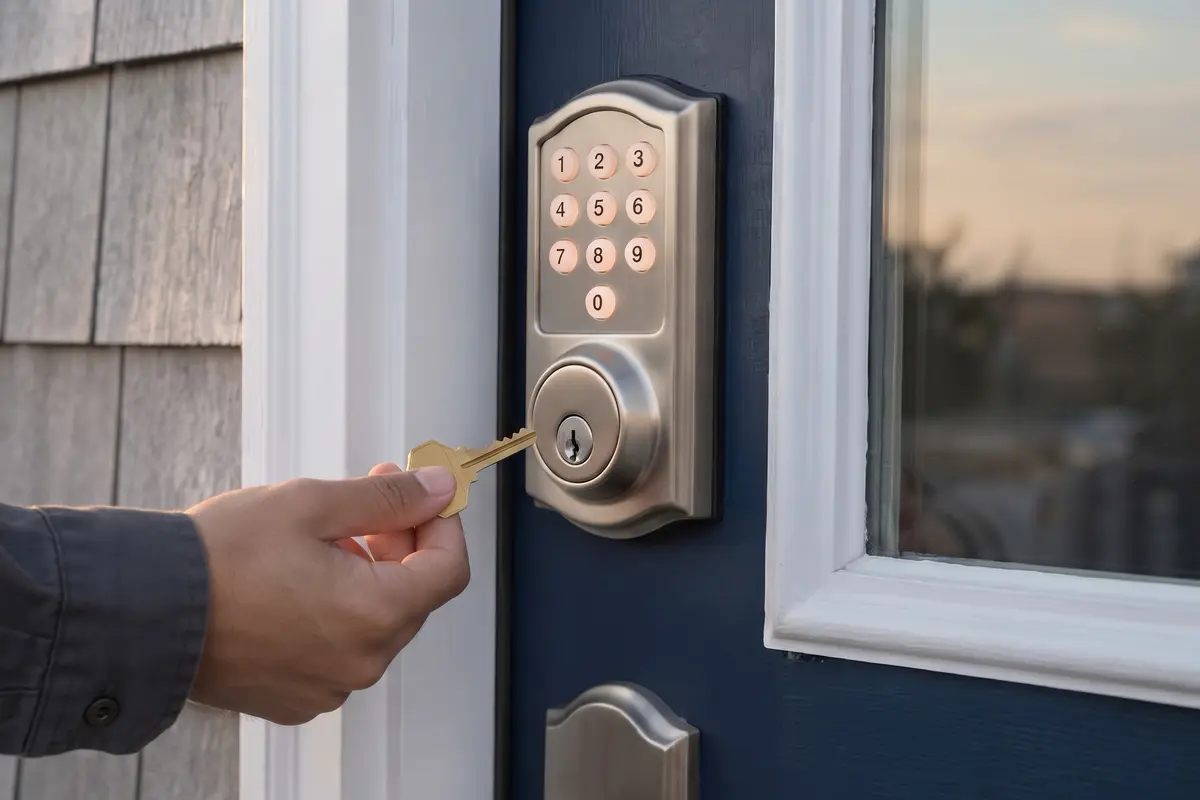
Most entry doors in the US have a 2-1/8 inch hole through the face and a 1 inch hole in the edge. The backset, which is the distance from the edge of the door to the center of that big hole, is usually 2-3/8 or 2-3/4 inches. Smart deadbolts from the big brands are made for that layout, and plenty of them come with an adjustable latch that covers both backsets.
Older doors are the problem. A hole that's worn out, oversized or drilled off-center won't hold a smart lock square. A patched edge won't either. Neither does a steel or fiberglass door with a thin skin around the bore. A locksmith can often sleeve or reinforce the hole, but you'd rather hear that before the lock is out of the box.
So measure:
- the width of the hole in the face of the door
- the backset, from the door edge to the center of the hole
- the thickness of the door
Write the numbers down and hold them up against the lock's spec sheet. Not sure how to measure? A photo of your current deadbolt with a tape measure next to it does the job, and you can send it with a service request.
Point 2: Does the door close without a fight?
A smart lock throws the bolt with a small motor. A regular deadbolt lets you lift the door, lean on it and wiggle the key until it goes. A motor can't do any of that. It tries, jams, and chews through its batteries while it does.
Here's the test. Close the door and turn your current deadbolt with one finger. If it moves easily, the bolt lines up with the hole in the frame. If you have to lift the door or push it shut first, it's out of alignment.
Coastal Sussex County makes this worse. Wood doors swell in the humidity, and salt eats thin strike plates. We cover finishes and materials in our post on door hardware that survives salt air. The fix is usually small, like a shimmed hinge, a strike plate moved a fraction of an inch or a re-cut mortise. Do it before the smart lock goes on.
Point 3: Will the lock stay connected?
Bluetooth-only locks work when your phone is near the door. Wi-Fi locks let you lock or unlock from the office or the beach. A few go through a hub, or use Matter or Thread. Pick based on whether you'll ever need to open the door from somewhere else.
Letting a cleaner in while you're at work? Then the lock has to be online. Stand at the front door and look at your phone's Wi-Fi bars. One bar means a Wi-Fi lock will keep dropping out. A mesh node, or a hub near the door, fixes most of that.
The router matters too, because the lock is one more device on your network. The Federal Trade Commission's guide to securing your home Wi-Fi network boils down to four moves. Use WPA3 Personal or WPA2 Personal encryption. Change the router's default admin name and password. Keep its software up to date. Set up a guest network. Do all four when the lock goes in and the basics are covered.
Point 4: What happens when the batteries die?
They will, and usually at a bad moment. What counts is what the lock does next.
Some chirp or send an app alert well ahead of time. The better ones also keep a real key cylinder, so a dead lock is a nuisance and not a lockout. A few have two contacts on the outside where you touch a 9-volt battery to get one more code in.
Questions worth asking at the store:
- Is there a key override, and where will the key live?
- How will the lock tell you the batteries are low?
- Can you power it from outside in an emergency?
- Who else has a code, and how do you take it away?
That last one gets skipped. Codes pile up. The cleaner, the contractor, the neighbor who fed the cat in July. Once a season, go through the list and delete any you can't explain. And if you end up outside with a dead lock and no spare, our home unlock service can get you in without damage.
What does the lock's grade tell you?
A smart lock is a deadbolt with electronics on it, so the deadbolt still has to be well made. In the US that's rated under the ANSI/BHMA system, where Grade 1 is the highest level of performance. Locks for homes are normally Grade 2 or Grade 3.
Locksmith Ledger's summary of the ANSI/BHMA residential standards says the A156.2 cycle test needs 800,000 cycles for Grade 1, 400,000 for Grade 2 and 200,000 for Grade 3. The impact tests step up the same way.
| Grade | Minimum test cycles (A156.2) | Where you usually see it |
|---|---|---|
| Grade 1 | 800,000 | Commercial doors, heavy use |
| Grade 2 | 400,000 | Many residential entry doors |
| Grade 3 | 200,000 | Basic builder hardware |
One caveat. The article is from 2010 and cites the 2003 edition of the standard, and standards change, so look at the maker's current spec sheet. A front door opens a dozen times a day, so we lean toward a Grade 2 deadbolt or better. If the box doesn't show a grade, ask the seller.
Renting in Delaware?
You can put a smart lock on a rental, with conditions. Under 25 Del. C. § 5509, a tenant may add a lock if:
- the tenant notifies the landlord in writing and supplies the landlord with a key to the lock
- the new lock fits into the system already in place
- the installation does not cause damage to the door
A smart lock with a key cylinder is the easy case, because you hand over a key. Code-only locks sit awkwardly with the "supply a key" rule. Check your lease, put the notice in writing and keep a dated copy. If you run a short-term rental, our guide to smart locks in a holiday rental covers changing codes between guests.
What happens when we install a smart lock at your door in Sussex County, DE?
We're a mobile locksmith based in Georgetown, so there's no shop to drive to. The van comes to your address anywhere in Kent and Sussex County. Our smart lock installation service covers locks like the Schlage Encode, Yale Assure and Kwikset Halo, from door prep and mounting to setting the first codes and app access. If you're nearby, there's a page for smart lock installation in Georgetown too.
Before a tool touches your door, we tell you the options and you choose. Sometimes that means fixing the alignment first. Sometimes it means saying a certain lock is a poor match for your door. If the deadbolt you have is worn out, we'll say that as well, and a lock rekey or a replacement may come first.
Phones are answered Sunday through Thursday, 7:00am to 10:00pm, and Friday, 7:00am to 3:30pm. We're closed Saturday. The request form takes messages at any hour and we reply when we open.
When you call, have these handy:
- your town and the address for the work
- the brand and model of the smart lock, or the one you're thinking about
- your three measurements, or a photo of the current deadbolt
- whether you own or rent
Frequently asked questions
Can any smart lock fit my front door?
Does a smart lock need Wi-Fi?
What happens to a smart lock when the power goes out?
Is a smart lock less secure than a regular deadbolt?
Can I install a smart lock myself?
Can renters in Delaware install a smart lock?
Who does smart lock installation in Sussex County, DE?
Do you install smart locks outside Georgetown?
Next steps
Run the check, jot down your measurements and work out how you'll handle backup keys and codes. Then request service with your town and the lock you have in mind, or call (302) 271-0155.
About the author
The team at Lock and Key Locksmith wrote this. We're a locally owned, mobile locksmith in Georgetown, Delaware, working across 50 towns in Kent and Sussex County, with 15 years of experience. Phones are answered Sunday to Thursday, 7:00am to 10:00pm, and Friday, 7:00am to 3:30pm.
Planning a smart lock? Call (302) 271-0155 and tell us your town and which door it's going on.