
House Lockout in Kent & Sussex County, DE
A house lockout usually starts with a steady stream of small details that add up. A key left on the kitchen counter, a purse dropped in the mudroom, a deadbolt locked from the inside after a quick step to the car. Sometimes the caller is standing on a porch with an armful of groceries, sometimes they are across the yard with a baby carriage. Often there is visible wear on the lock or a warped edge on the door where moisture has swollen the frame. We arrive in a fully equipped van, not a shop, and meet whatever situation the homeowner describes. We listen for which door was used last and whether any windows or secondary doors are accessible, then plan what tools and methods to use without damaging the house.
On site we start by confirming the entry point and the type of lock. For a standard single-cylinder deadbolt we check the exposed screws, the strike plate, and the gap at the jamb. For knob locks or tubular latches we may use pick sets or a plug spinner; for mortise locks we inspect the case and the faceplate. If there is a smart lock we check the power and whether a mechanical override exists. For sliding glass doors we examine the sash and the security bar, and for French doors we look at flush bolts. Our van carries picks, bypass tools, interchangeable lock cylinders, and drills when a destructive method is the only option. We proceed step by step, starting with non-destructive options and moving to controlled destructive entry only when necessary.
Whether the job is straightforward or awkward depends on the lock hardware, the door construction, and any obstacles around the opening. A basic Kwikset or Schlage single-cylinder deadbolt on a solid wood door is often easier to manipulate than an older mortise lock that rusted in place or a high-security cylinder with a restricted keyway. Doors built from aluminum or fiberglass can conceal reinforcing plates or have thinner jambs that affect how tools engage. Multi-point locking systems on some newer fiberglass or composite doors latch at several points and complicate single-point solutions. A vehicle parked tight to the path, a narrow stoop, or a locked security gate can limit our working angle or force us to use smaller tools and different access tactics.
When the door is open we make sure the lock and surrounding hardware are left in safe, usable condition. If a cylinder was removed we either rekey it or install a replacement that fits the existing door, and we align the strike plate and latch so the bolt operates smoothly. If a small portion of wood or the frame was trimmed or mortised we clean sharp edges and test the door through several cycles. For smart locks we verify batteries and that the mechanical override works. Before we pack up our van we check that windows and alternate entries remain secure, that the homeowner has any original keys we removed, and that the lock operates from both sides. We leave clear about any further repair needs the door may have.
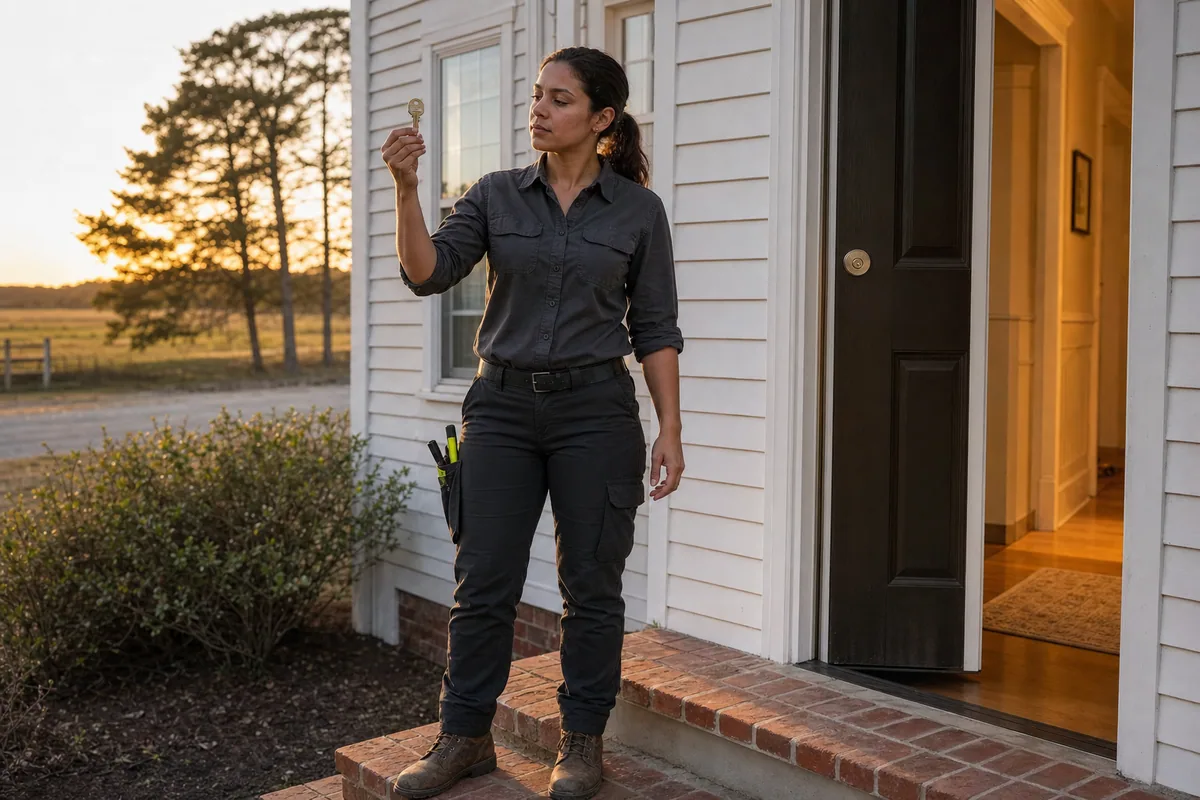
House Lockout in 50 Delaware towns.
House Lockout is part of our emergency work, and each of the 50 towns below has its own house lockout page describing what the job looks like at an address there and how far it sits from Georgetown.
Other emergency work.
Need house lockout?
House Lockout in any of 50 towns across Kent and Sussex County.